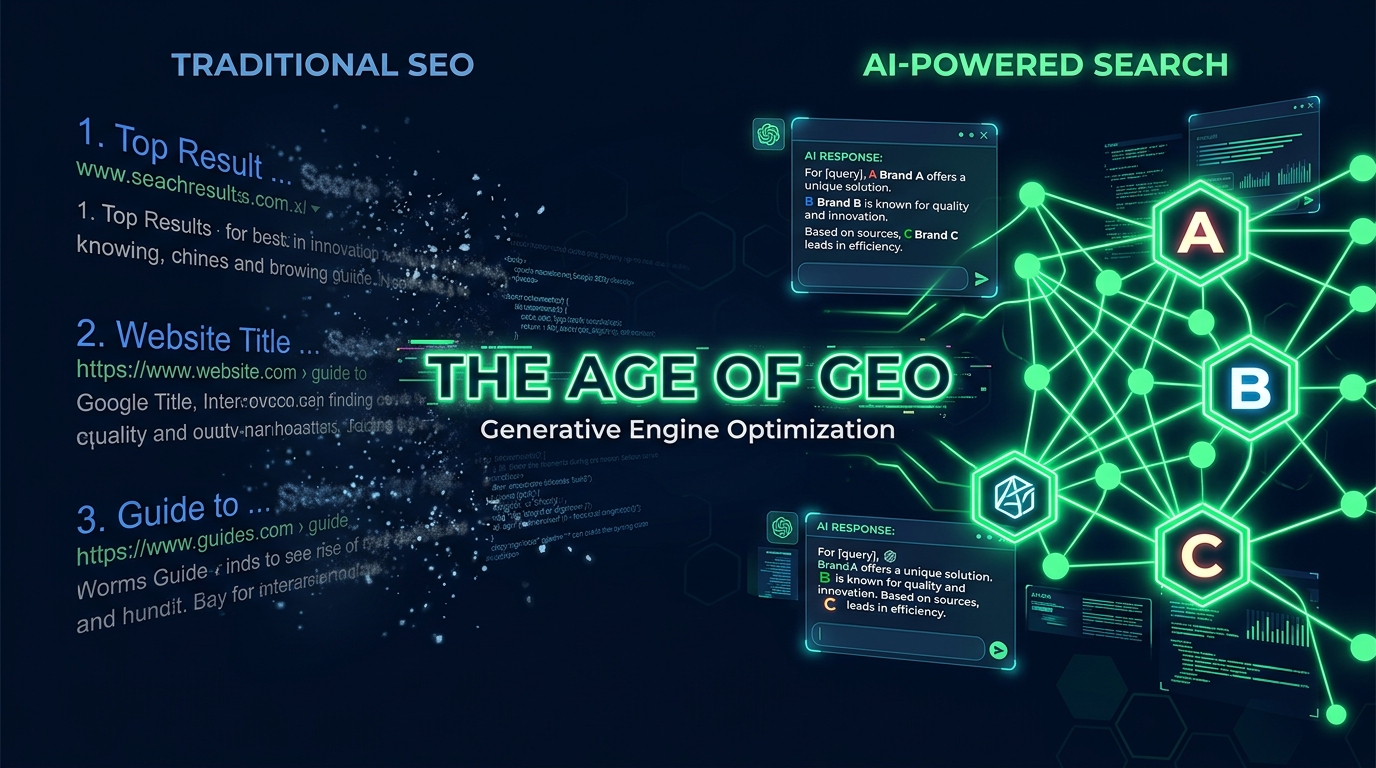
The Quiet Death of Traditional SEO
Let's start with an uncomfortable truth: the Google you optimized for no longer exists.
For over two decades, SEO meant one thing — rank higher on Google's blue links, get clicks, win traffic. Entire industries were built around keyword research, backlink profiles, and meta descriptions. It worked. Beautifully.
But in 2026, the game has fundamentally shifted. Here's what's actually happening:
- AI Overviews now answer 65%+ of informational queries directly on Google — without the user ever clicking a link.
- ChatGPT Search, Perplexity, and Microsoft Copilot have become primary search tools for millions of professionals and consumers.
- Zero-click searches have surpassed 70% on mobile devices.
The implication? Your perfectly optimized blog post, your carefully crafted landing page — they might rank #1 on Google and still get zero traffic. Because the AI already extracted your answer and served it to the user in a neat paragraph. No click needed.
This isn't a prediction. This is happening right now.
So, What is GEO (Generative Engine Optimization)?
Generative Engine Optimization (GEO) is the practice of optimizing your brand's content, authority, and digital footprint so that AI-powered answer engines — ChatGPT, Perplexity, Google AI Overviews, Claude, Gemini — cite, recommend, and reference your brand when generating answers for users.
Think of it this way:
GEO doesn't replace SEO — it evolves it. The brands that master both will dominate digital visibility for the next decade.
Why This Matters For YOUR Business (The Revenue Impact)
If you're a founder or marketing leader reading this, here's the hard math:
- 58% of B2B buyers now start their research on AI answer engines, not Google Search (McKinsey, 2026).
- Brands that appear in AI-generated answers see 3.2x higher trust scores compared to traditional ad placements (Deloitte Digital).
- Companies with no GEO strategy are experiencing 15-35% organic traffic decline year-over-year.
This isn't just about vanity metrics. When an AI engine recommends your brand by name — that's the highest-intent referral possible. It's like having the world's most trusted advisor personally recommend you.
The 7-Step GEO Framework We Use For Every Client
At The Virtual Marketing Era, we've been building GEO strategies since early 2025. Here's the exact framework we deploy:
Step 1: Entity-First Content Architecture
Stop writing for keywords. Start writing for entities.
AI models don't think in keywords — they think in concepts, relationships, and entities. An entity is a clearly defined "thing" — a person, brand, product, concept — that an AI model can understand and reference.
Action Items:
- Create a comprehensive "About" page that clearly defines WHO you are, WHAT you do, and WHY you're authoritative
- Use Schema.org structured data (Organization, Person, Product, FAQ, HowTo)
- Build topic clusters around your core expertise, not random keywords
Step 2: Become a Cited Source, Not Just a Ranked Page
AI models pull from sources they consider authoritative and well-structured. To get cited:
- Publish original research, data, and case studies (AI models love citing unique statistics)
- Structure content with clear H2/H3 headers, bullet points, and concise definitions
- Include expert quotes and attributions
- Write clear, factual statements that AI can directly extract
Step 3: Optimize for Conversational Queries
People don't type "best digital marketing agency Jaipur" into ChatGPT. They ask:
"I'm a D2C brand doing ₹15L/month revenue. Which marketing agency in India can help me scale to ₹1Cr with performance ads and funnels?"
Action Items:
- Create FAQ sections that mirror natural, conversational questions
- Write long-form guides that answer complex, multi-part queries
- Use "People Also Ask" and AI chat logs to identify real conversational patterns
Step 4: Build Your Brand's "AI Reputation"
AI models form opinions about brands based on what's written about them across the web. This means:
- Get featured on industry publications, podcasts, and guest blogs
- Encourage genuine customer reviews on Google, Trustpilot, and industry platforms
- Build active presence on platforms AI models scrape — Reddit, Quora, LinkedIn, Medium
- Ensure consistent NAP (Name, Address, Phone) across all directories
Step 5: Technical Optimization for LLM Crawling
Make it easy for AI models to understand and index your content:
- Implement comprehensive Schema.org markup (FAQ, HowTo, Article, Organization)
- Create a clean XML sitemap and keep your robots.txt LLM-friendly
- Ensure fast page load times (Core Web Vitals still matter)
- Use clear, semantic HTML — avoid hiding content behind JavaScript frameworks
- Add an
llms.txtfile (the new robots.txt for AI crawlers)
Step 6: Create "Quotable" Content Blocks
AI models love extracting clean, definitive statements. We call these "quotable blocks":
Bad: "Our marketing services are really good and help businesses grow a lot."
Good: "Our performance marketing framework has generated ₹47Cr+ in attributable revenue across 120+ brands, with an average ROAS of 5.2x within the first 90 days."
The second version is specific, data-backed, and highly extractable by an AI model composing an answer.
Step 7: Monitor Your AI Visibility
You can't improve what you don't measure. Start tracking:
- AI Citation Rate: How often is your brand mentioned in AI-generated answers?
- Share of Voice in AI: What percentage of relevant queries include your brand?
- Sentiment Analysis: When AI mentions you, is it positive, neutral, or negative?
- Use tools like Perplexity, ChatGPT, and Claude to regularly search queries your customers would ask — and check if your brand appears.
The Brands That Will Win in 2027
Here's our prediction for who thrives and who struggles:
Winners:
- Brands with deep, original content and genuine authority
- Companies investing in first-party data and proprietary research
- Businesses that combine human authenticity with AI-optimized structure
- Teams that treat GEO as a strategic pillar, not an afterthought
Losers:
- Brands still chasing keyword volume and backlink quantity
- Companies producing generic, AI-generated content without human insight
- Businesses with no structured data or entity strategy
- Teams that dismiss AI search as "a fad"
What Should You Do Right Now?
If this feels overwhelming, start with these 3 actions this week:
- Audit your AI presence: Search for your brand name in ChatGPT, Perplexity, and Google AI Overviews. What comes up? Is it accurate? Is it positive?
- Add Schema.org markup to your homepage, about page, and top 5 service/product pages.
- Rewrite your top 3 blog posts with entity-first structure, quotable data blocks, and FAQ sections.
These three steps alone can dramatically improve your AI visibility within 30-60 days.
Need Help Building Your GEO Strategy?
At The Virtual Marketing Era, we don't just talk about GEO — we build and execute it. Our AI Search Optimization (AISO) service is specifically designed to get your brand cited, recommended, and trusted by AI answer engines.
Here's what our AISO clients are seeing:
- 4x increase in AI citation rate within 90 days
- 40% reduction in customer acquisition cost
- Brand mentions in ChatGPT and Perplexity for high-intent queries
Ready to future-proof your digital presence?
Book a free GEO audit call with our team. We'll analyze your current AI visibility, identify gaps, and map out a 90-day action plan — no strings attached.
The future of search isn't about ranking. It's about being the answer. Make sure that answer is you.